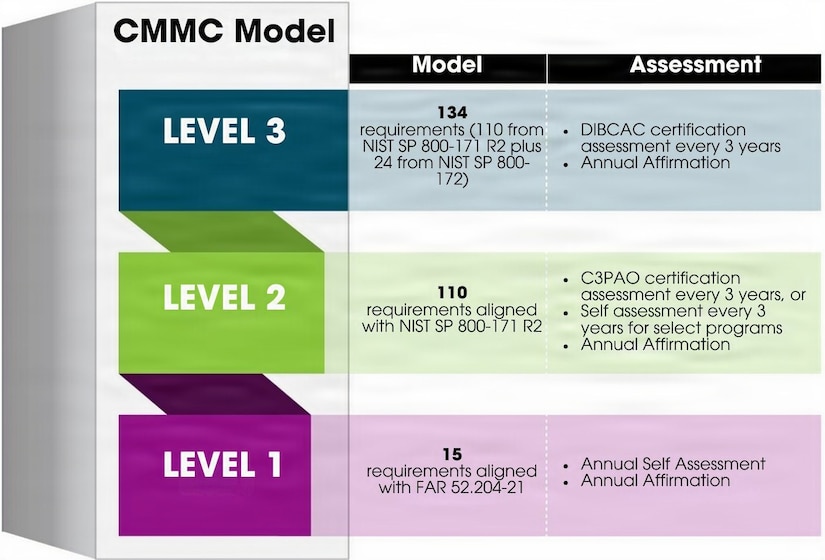
The Cybersecurity Maturity Model Certification (CMMC) is the War/Defense Department’s standardized cybersecurity program for companies in its supply chain. It is designed to make sure any contractor or subcontractor that handles Federal Contract Information (FCI) or Controlled Unclassified Information (CUI) has actually put required security controls in place, not just promised to do so.
How it works, in simple terms:
Tiered levels (3 levels):
Assessments and records: Assessment results and affirmations are recorded in government systems (such as SPRS and eMASS), and a company’s CMMC “status” must be current to win and keep eligible contracts.
Tied to contracts: Each new War/DoD contract that involves FCI or CUI will state the CMMC level required. A company cannot receive that award unless it already meets that level (or, in limited cases, has an approved conditional status plus a remediation plan).
Limited use of Plans of Action & Milestones (POA&Ms): At Levels 2–3, only certain gaps can be temporarily left open under a POA&M, which must be fully closed (and re‑assessed) within 180 days or the conditional status expires.
Overall, CMMC turns previously self‑policed cybersecurity rules into a mix of self‑assessments, third‑party audits, and government audits, all directly linked to eligibility for War/DoD contracts.
Under earlier rules, most defense contractors only had to self‑attest that they followed required cybersecurity standards (like NIST SP 800‑171) when handling sensitive data, including service member information. CMMC strengthens protection of that data in several concrete ways:
Verification instead of “trust only”:
Mandatory implementation of technical controls:
Continuous accountability:
Together, these changes are meant to reduce the chance that systems holding service member data are left with unaddressed security gaps, compared with the older model of largely unverified self‑attestations.
CMMC applies broadly across the U.S. defense industrial base to almost all organizations that handle War/DoD contract information, with limited exceptions.
Required to comply:
Generally exempt or not covered:
In practice, the vast majority of non‑COTS contractors and subs in the defense supply chain that touch FCI or CUI will have to meet a specified CMMC level once the program is fully phased into contracts.
Yes. CMMC compliance is being phased in over multiple years through War/DoD contracts, with explicit phase dates and deadlines.
Key timing and phases:
Program/legal basis:
Phase 1 (Nov 10, 2025 – Nov 9/10, 2026):
Phase 2 (Nov 10, 2026 – Nov 9, 2027):
Phase 3 (overlapping period around Nov 10, 2026 – Nov 9, 2027, per implementing guidance):
Phase 4 (beginning Nov 10, 2028):
Thus, CMMC requirements appear in a growing share of new solicitations between late 2025 and late 2028; by late 2028, being at the required CMMC level is effectively mandatory for all applicable contracts.
Yes. CMMC introduces new assessment and compliance obligations that carry real costs, which can be significant for small and specialized contractors, although the program has been adjusted in part to reduce that burden.
New requirements and potential impacts:
Direct assessment and affirmation costs:
Implementation/upgrade costs:
Program changes meant to ease burden, especially for small businesses:
In short, CMMC will impose new, sometimes substantial compliance and audit costs, particularly on small and specialized defense contractors, even as the 2.0 design attempts to moderate those impacts and offer support resources.
Responsibility for CMMC policy and program execution now sits primarily with the War/Defense Department’s Chief Information Officer (CIO) and the dedicated CMMC program office under that CIO, with additional roles for other offices in assessments and contracting.
Key organizations and officials:
DoD/War Chief Information Officer (CIO):
CMMC Program Office under the CIO:
Defense Contract Management Agency (DCMA) – Defense Industrial Base Cybersecurity Assessment Center (DIBCAC):
Contracting community (through DFARS clauses):
Together, the CIO/CMMC Program Office sets and oversees the program, DCMA DIBCAC performs top‑tier government audits, and contracting officers enforce compliance via contract terms and award eligibility.